
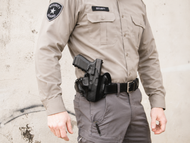
Top Police Gun Holsters for Law Enforcement Officers
Jul 22nd 2026
Duty Holsters, At a Glance
A police gun holster keeps an officer's sidearm secure during patrol while allowing a fast, reliable draw when it counts. The best police gun holsters pair strong weapon retention with quick access, fit the officer's firearm and duty belt correctly, and stand up to daily field use. Most uniformed officers carry a Level II or Level III duty holster for that balance.
Choosing the right police duty holster affects officer safety on every shift. A holster that releases too easily creates a weapon-grab risk, while one that locks too tightly can slow a draw under stress.
Below, we break down what separates a quality police gun holster from the rest.
What Makes a Good Police Gun Holster?
A duty holster does more than hold a pistol. It protects the firearm from grabs, keeps it in place during foot pursuits and physical struggles, and presents the handgun at a consistent angle every time the officer reaches for it. A few features separate a reliable police gun holster from a weak one.
- Weapon retention: The holster should resist attempts to pull the firearm free, whether from an attacker or simple movement. Retention comes from friction, locking mechanisms, or both.
- Proper fit: A duty holster is molded for a specific handgun model. A loose fit lets the pistol shift, while a tight, gun-specific fit holds it square to the body.
- Duty belt compatibility: Patrol holsters mount to a rigid gun belt, not a dress belt. A wide, reinforced belt loop or paddle keeps the holster stable under load.
- Material strength: The holster body has to survive weather, sweat, and constant contact with vehicle seats and gear.
- Accessibility: A clean, repeatable draw matters as much as security. Officers train the same draw stroke thousands of times.
- Light and optic clearance: Many duty pistols now carry a compact light or red dot sight. The holster must fit the firearm with those accessories attached. The Duty Raptor light-bearing model accommodates GLOCK pistols with a pistol light attached.
Officers carry support gear alongside the holster, such as magazine pouches and a cuff case, all mounted to the same duty belt. A matched system keeps law enforcement gear organized and within reach. Accessories such as the Infiltrator handcuff pouch and the Radio Tender mount to that same belt to round out the setup. When a holster shows wear or is in need of repair, it should be replaced rather than patched, since a failing retention device puts officer safety at risk.
Holster Retention Levels Explained
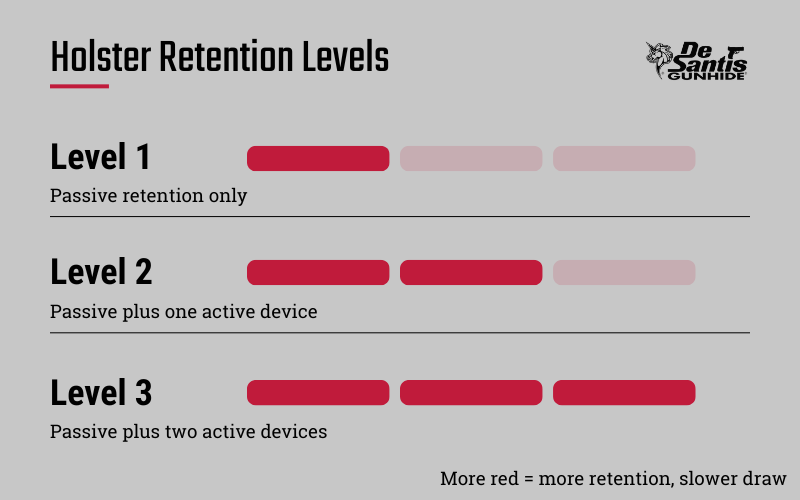
Retention describes how well a holster holds a firearm against an unwanted pull. The level system used across law enforcement traces back to a testing protocol developed by former FBI agent and police instructor Bill Rogers in the 1970s (Source: Police1, 2015). There is no single government standard that defines every level, so manufacturers apply the categories in slightly different ways. The general framework, however, is widely understood.
Each level reflects how many actions an officer must perform to clear the firearm from the holster:
- Level I: Passive retention only, usually friction or an adjustable tension screw. The handgun stays put under normal movement but draws quickly.
- Level II: Passive retention plus one active mechanism, such as a thumb break or rotating hood, that the officer must release on the draw.
- Level III: Passive retention plus two active security features that release in sequence, built to defeat weapon-grab attempts during a close struggle. The Duty Raptor self-locking model carries two locking mechanisms, and the Just Cause Safety Holster pairs a rotating hood with a self-locking, thumb-activated trigger guard lock.
A higher level of retention makes it harder for an armed individual to snatch a holstered firearm, but it also adds steps to the draw. That tradeoff is why agencies weigh speed against security when they pick a duty holster. Most uniformed patrol officers land on Level II or Level III, since both give real protection while keeping the draw workable under pressure. Higher retention levels call for steady, repeated training so the release becomes automatic. The Tap Out duty system is ambidextrous, so left and right handed officers across a department can train the same draw. The right level of retention depends on the officer's assignment, threat environment, and police department policy.
Holster Materials for Duty Use
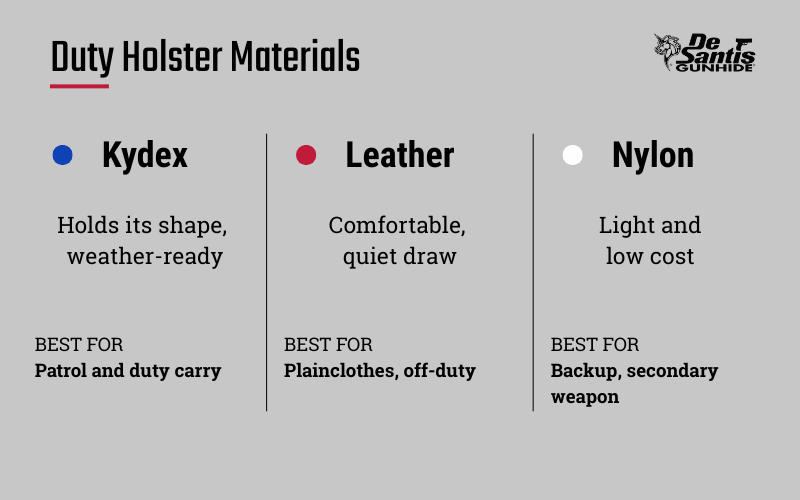
The material behind a police gun holster shapes its retention, comfort, and service life. Three options dominate law enforcement duty holsters, and each suits a different priority.
Kydex
A molded thermoplastic that holds a precise shape and gives a sharp, audible click on re-holstering. It resists moisture, cleans easily, and supports the active locking systems found on many Level II and Level III duty rigs. For patrol officers who want consistent retention and a fast draw, a Kydex duty holster is a strong choice. DeSantis builds its Kydex duty rigs around these locking systems, including the Duty Raptor, the Just Cause Safety Holster, the Tap Out, and the cant, height, and tension-adjustable Triple Play.
Product Spotlight: DeSantis Quick Safe
The Quick Safe is a self-locking, outside-the-waistband Kydex holster from DeSantis GunHide. It surpassed U.S. Customs and Border Protection testing standards typically reserved for Level III duty rigs while keeping a fast draw, and it has been approved by CBP and the Federal Protective Service (Source: The Outdoor Wire, 2026).
It fits popular GLOCK models, including versions equipped with red dot sights and weapon lights.
Watch: World champion shooter and instructor Todd Jarrett reviews the Quick Safe in this video walkthrough. For more product demos, visit the DeSantis GunHide video library.
Leather
This offers a classic feel and a quiet draw, and a quality leather holster molds closely to the firearm over time. It stays popular for plainclothes work, off-duty carry, and officers who value comfort against the body.
Nylon
These holsters are lightweight and budget-friendly, often used for backup or secondary weapon carry rather than primary duty use.
Many officers also keep an IWB holster or a paddle holster for off-duty and plainclothes assignments, while a mid-ride belt holster keeps the primary sidearm at a natural draw height on the duty belt.
Material choice ties back to the role. A uniformed officer needs a secure, weather-resistant duty holster, while that same officer may want a lighter, more concealable handgun holster for off-duty hours. DeSantis builds police gun holsters across all three materials, with handmade quality and gun-specific molding on every unit.
Police Gun Holster FAQs
What retention level do most police officers use?
Most uniformed patrol officers carry a Level II or Level III duty holster. These levels help protect against weapon grabs while keeping the draw fast enough for field use.
Are Kydex or leather holsters better for police duty?
Kydex holds a precise shape, resists moisture, and pairs well with active retention systems, which makes it a common choice for patrol. Leather offers a quieter draw and comfortable feel, so it is often preferred for plainclothes or off-duty carry.
What is active retention?
Active retention is any security device an officer must deliberately release to draw, such as a thumb break or locking hood. It differs from passive retention, which relies on friction alone to hold the firearm in place.
How often should a duty holster be replaced?
Replace a duty holster when the retention device weakens, the shell cracks, or the fit loosens. A holster that needs repair should be retired, since it may not provide reliable retention when it matters most.
Choosing the Right Police Gun Holster
The best duty holster matches your firearm, your assignment, and your department's policy, while letting you draw the same way every time. Start with the retention level your role calls for, confirm the holster is molded for your exact handgun and any light or optic, and mount it on a proper gun belt for stability. Follow your agency's guidelines and any applicable state or federal law when selecting law enforcement gear. Quality materials and a precise fit protect both the firearm and the officer who carries it.
DeSantis GunHide has built handmade police gun holsters in the USA since 1972, supplying federal agencies and law enforcement professionals worldwide (Source: DeSantis GunHide). Explore the DeSantis law enforcement and duty gear collection to find a police duty holster molded for your sidearm, or browse the full line of Kydex, leather, and nylon holsters built for duty use. Your holster is one of the most important pieces of gear you carry, so choose one tested to hold up when it matters most.
