
Open Carry vs. Concealed Carry: Understand the Difference
Aug 19th 2026
Two Ways to Carry, Two Different Conversations
The choice between open carry and concealed carry changes your holster, your wardrobe, your legal footing, and how strangers react to you.
At a Glance:
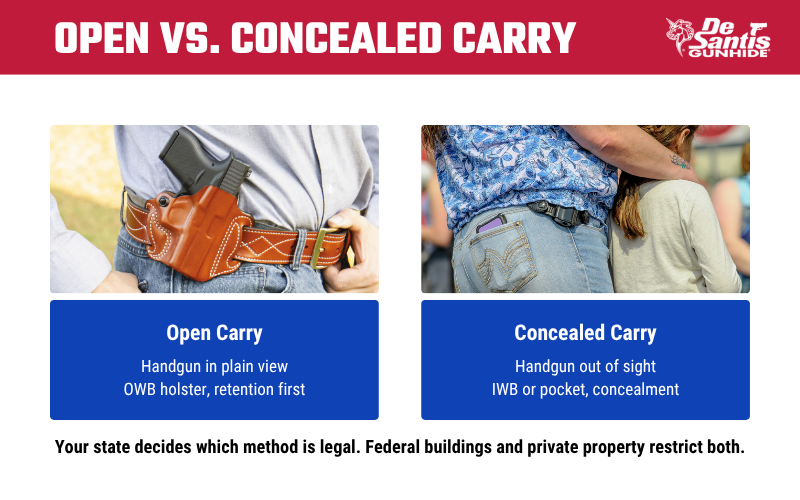
- Open carry means a visible handgun worn where the public can see it. Concealed carry means the firearm stays hidden from view.
- Permit rules differ. Some states require a concealed carry license for one and not the other, and a handful reverse that.
- Federal law sets a floor that no state permit overrides, including felony convictions, controlled substance use, and restricted locations.
- Open carry favors a secure OWB rig with retention. Concealed carry favors an IWB or pocket holster that disappears under a shirt.
- Private property owners and private businesses can prohibit firearms regardless of what your state allows.
- Your belt matters as much as your holster in either case.
Open carry and concealed carry describe how a firearm is worn, not what kind of gun you own. The distinction sounds simple, and then state law, location restrictions, and eligibility requirements turn it into something worth understanding before you leave the house.
What Open Carry Means
Open carry is the practice of wearing a firearm in plain view, most often in a belt holster on the strong side hip. The handgun is not covered by a jacket, an untucked shirt, or anything else. In most states that allow it, a visible handgun must be carried in a holster rather than tucked into a waistband.
Who you see doing it varies. A police officer in uniform is open carrying. So is a security guard, a rancher on his own property, a hunter with a sidearm alongside a long gun, and a gun owner running errands in a state where the practice is common.
The practical arguments for open carry come down to access and comfort:
- A visible handgun draws faster with no cover garment to clear.
- A full-size pistol rides more comfortably outside the waistband than inside it.
- Larger guns, lights, and red dots fit an OWB rig without printing problems.
The arguments against it are about attention. Open carry announces that you are armed, which some people consider a deterrent and others consider a liability. It also invites conversations with law enforcement, business owners, and strangers that a concealed carrier never has.
What Concealed Carry Means
Concealed carry means a concealed firearm is kept out of sight, typically inside the waistband, in a pocket, on an ankle, or in a shoulder rig under a jacket. Nobody around you knows the gun is there. This is the practice DeSantis has built its reputation on for nearly fifty years.
Concealment means accepting tradeoffs. A concealed pistol carried inside the waistband sits closer to the body and requires a cover garment. Drawing takes an extra motion. Many carriers move to a smaller gun. In exchange, you keep the tactical advantage of surprise, and you avoid the social friction that comes with a visible gun.
Concealed carry is also the more portable choice across state lines. Far more jurisdictions permit a concealed weapon than permit open carry in urban settings, and a concealed handgun permit from your home state often carries reciprocity that an open carry practice does not.
Where the Law Draws the Line
This article is general information and not legal advice. Firearm laws change; they vary enormously between states, and the only reliable source is your state's own statutes and your attorney general's office, which usually publishes additional information for carriers.
That said, a few patterns hold across the United States:
- Permitless carry has spread. A majority of states now allow eligible adults to carry a concealed handgun without a permit, a shift that accelerated over the last decade.
- Shall-issue is the standard. In 2022, the Supreme Court read the Second Amendment to protect public carry and ruled in New York State Rifle and Pistol Association v. Bruen that states cannot require applicants to demonstrate a special need for a carry license, which ended discretionary may-issue systems and reframed how courts weigh constitutional rights against carry restrictions.
- Open carry rules are not the same as concealed rules. Some states allow open carry with no permit but require a concealed carry license for a hidden gun. Others do the reverse. A few prohibit open carry of a handgun outright.
Texas is a useful example because the Texas Penal Code spells it out. Under Section 46.02, a person must generally be 21 years of age or hold a handgun license to carry a handgun in public; the gun must be in a holster if it is visible, and separate rules apply inside a motor vehicle. A new law in 2021 dropped the license requirement for most carry, but the license still exists and still carries advantages.
Vehicles get their own rules almost everywhere. Some states let you keep a loaded handgun in a glove compartment or console without a permit, others treat that as concealed carry, and a few require the gun to be unloaded and locked. Check your state before you assume the car is an extension of your home.
Permits, Eligibility, and Background Checks
Even in permitless states, a concealed weapons permit is worth having. States call it different things, from a concealed pistol license to a concealed handgun permit to a simple carry license, and the name on the card does not change what it does. A valid permit usually means reciprocity when you travel, faster purchases at a dealer, and clearer standing if you are stopped.
Getting one generally involves:
- Meeting a minimum age, commonly 21 years of age, though some states set it lower.
- Passing a background check through state and federal databases.
- Completing a training course covering firearm laws, safe handling, and often live fire.
- Submitting fingerprints and an application to your state police or department of public safety.
Federal law disqualifies certain people regardless of state rules. Felony convictions, unlawful use of a controlled substance, certain domestic violence convictions, and other categories under 18 U.S.C. 922(g) bar firearm possession entirely. No state carry license overrides that.
| Your state's framework | Open carry | Concealed carry | What it means for your setup |
|---|---|---|---|
| Permitless for both | No permit needed | No permit needed | Pick on comfort, not paperwork. A permit still helps when you travel. |
| Permitless concealed, permit for open | License required | No permit needed | IWB is the simpler default until the license clears. |
| Permitless open, permit for concealed | No permit needed | License required | An OWB rig gets you carrying now. Apply before you switch. |
| Permit required for both | License required | License required | Start the application first. Buy the holster while you wait. |
| Open carry prohibited | Not an option | License required | Concealment is the only path. Build around an IWB or pocket rig. |
Rules change by legislative session, and several states carve out exceptions for vehicles, private property, and specific cities. Confirm your own state before you carry either way.
Where You Cannot Carry Either Way
Restricted locations apply to open and concealed carry alike, and this is where permit holders get into trouble most.
- Federal facilities. Possessing a firearm in a federal building is a federal offense, with narrow exceptions.
- School zones. Federal law restricts firearms within 1,000 feet of a school, with an exception for people licensed by that state, which is one of the better arguments for holding a permit.
- Secure government sites. Correctional facility grounds, a law enforcement facility, courthouses, and secure areas of airports.
- Private property. Owners and private businesses can post their premises and refuse entry to anyone carrying, whether the gun is visible or not.
A qualified law enforcement officer, active or retired, has separate authority to carry a concealed firearm across state lines under the Law Enforcement Officers Safety Act, which is why a duty rig and a plain clothes rig often live in the same locker. Recent proposals in Congress would widen where that authority applies.
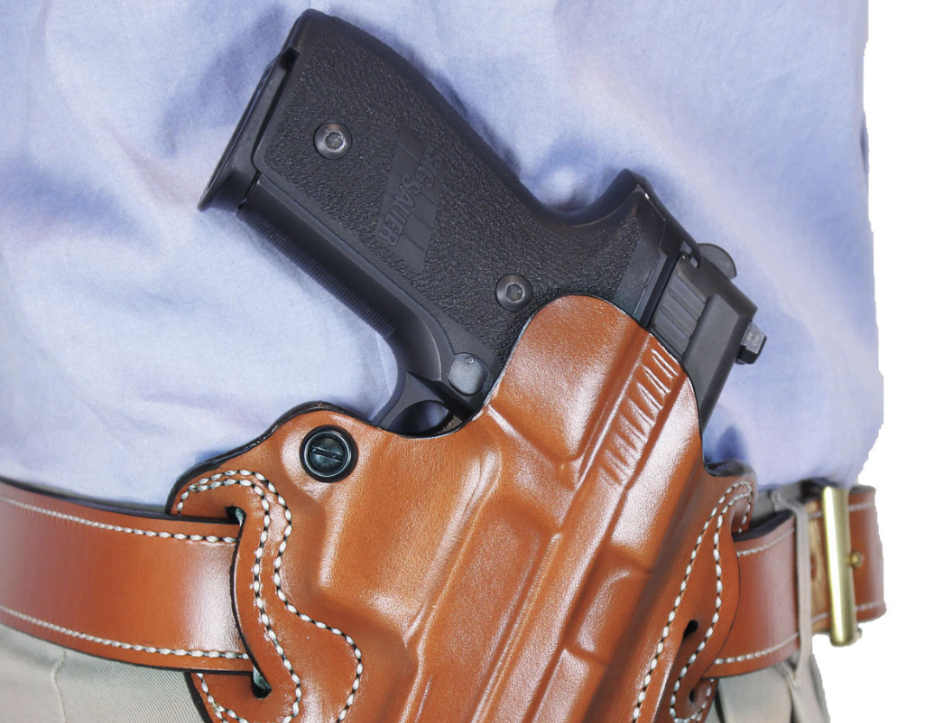
Holsters Built for Open Carry
Open carry puts your gun where people can see it and where they could reach it. Retention becomes the priority.
- The Speed Scabbard is a longstanding DeSantis OWB design that holds a pistol tight to the body with a rigid mouth for one-handed reholstering.
- Duty holsters add active retention levels for law enforcement, security, and anyone carrying in a professional capacity.
- Pegasus Kydex OWB models offer adjustable retention, hard shell protection, and compatibility with lights and optics.
- Paddle holsters let you remove the rig without unthreading your belt, which suits a gun owner who carries at home or in a vehicle.
Whatever you choose, pair it with a real gun belt. A gun that shifts under its own weight is a gun that prints, sags, and draws poorly.
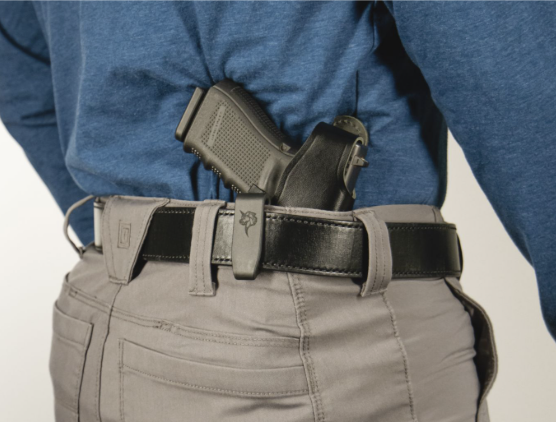
Holsters Built for Concealed Carry
Concealment is about eliminating a visible outline while keeping the draw clean.
- IWB holsters pull the pistol inside the waistband, which is the most common concealed carry position.
- Pegasus Kydex IWB models give you a thin, molded shell with a consistent draw and adjustable ride and cant.
- Pocket holsters break up the outline of a small pistol and keep it oriented correctly.
- Ankle rigs serve as a backup option or a solution for seated carry in a motor vehicle.
- Shoulder rigs work well under a jacket for anyone who spends the day driving.
If you are deciding between materials, our guide to leather or kydex walks through how each behaves over time. For help narrowing options by gun and body type, start with our guide on choosing a concealed carry holster, and if you are new to the vocabulary, what EDC stands for covers the basics.
Which One Is Right for You
Ask three questions. What does your state actually allow for each method? What does your daily routine look like, including whether you enter buildings that prohibit firearms? And what are you willing to accept in comfort and attention?
Most carriers land on concealed carry for daily life and keep an OWB rig for the range, the woods, or the property. That is not a compromise. It is two tools for two situations, and the same pistol can live in both.
Carry It Right
Open carry and concealed carry both come down to the same thing once the legal questions are settled: a holster that holds your firearm securely, releases it predictably, and does it the same way every time.
Browse the DeSantis GunHide lineup of American-made holsters and find the rig that fits how you carry.
