
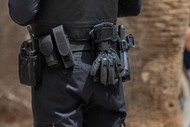
Police Duty Belt Essentials
Aug 19th 2026
What Rides on Your Hip Is a Decision You Make Once
A duty belt is the only piece of equipment an officer wears every single shift, and the layout you settle into becomes muscle memory whether you planned it or not.
At a Glance:
- A duty belt is a rigid outer belt worn over an inner belt, joined by belt keepers so the load stays put.
- The core load is a holster, handcuffs, magazine pouches, pepper spray, a radio, and a flashlight.
- Weight distribution matters as much as what you carry, since duty gear is a documented contributor to lower back pain in law enforcement.
- Leather, nylon, and laminate each behave differently in weather and wear.
- DeSantis has built duty gear for law enforcement agencies for nearly fifty years, including the Veritas line made for 2.25-inch belts.
- Set your layout once, then train on it until you can find every item without looking.
Policing is a job where the difference between having a tool and reaching for it is measured in seconds. The Bureau of Labor Statistics has put the on-the-job fatality rate for police and sheriffs' patrol officers at roughly five times the rate across all U.S. industries, which is the argument for treating belt setup as a professional decision rather than a matter of habit.
What a Duty Belt Actually Is
A police belt, or duty belt, is a two-belt system. An inner belt threads through your trouser loops and stays there. The outer belt, usually 2.25 inches wide and stiffened to hold its shape, carries the gear and attaches to the inner belt with belt keepers.
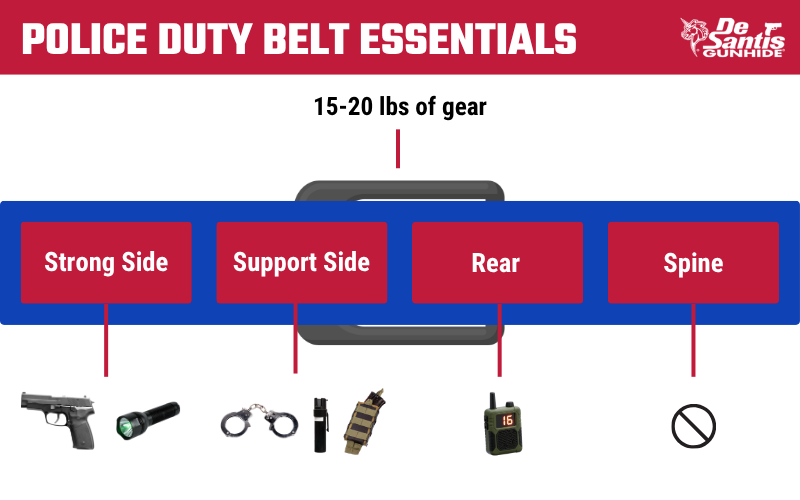
That design exists for a reason. A single belt carrying fifteen to twenty pounds of tools will sag, rotate, and shift every time you sit in a patrol car. The two-belt system locks the load in place and lets you remove the whole rig at the end of a shift without undressing.
You will see the same architecture on a battle belt or a tactical belt worn by security personnel and public safety officers. However, duty belts tend to run wider and stiffer than their tactical counterparts. The same logic drives most tactical gear: anchor the load, then build outward from it.
Why Load Placement Matters
This is the part that gets skipped, and it costs officers careers. Research on law enforcement duty belts has found that roughly 60 percent of officers report low back pain, with the belt regularly named as a contributing factor. A lower back injury does not usually arrive in one dramatic moment for a police officer. It accumulates across a decade of shifts spent sitting on an unbalanced load. Sustained external pressure at the waistline is also a documented cause of nerve irritation at the hip, which shows up as burning or numbness down the outer thigh.
A few principles reduce that risk:
- Balance weight across both hips rather than loading one side.
- Keep the small of your back clear. Anything there presses into your spine every time you lean against a seat.
- Position the heaviest items where your body is widest, not where there happens to be space.
- Fit the belt to your actual waist size rather than sizing up and cinching down.
Discomfort is not a toughness problem. It is a setup problem, and it is fixable.
1. The Belt Itself
Everything else hangs off this, so buy it first. A heavy-duty belt holds its shape under load instead of folding around the weight. The best duty belt for you is the one that fits your waist size correctly and stays rigid across a full shift, not the one with the longest feature list.
Duty belts are built differently from the gun belts a plainclothes officer wears off duty. A concealed carry belt supports one holster and a magazine. A duty belt supports the whole kit, which is why width and rigidity climb.
- Leather duty belts hold a classic look, take a shine, and stiffen appropriately over time.
- Nylon belts and nylon duty belt options run lighter and shrug off weather.
- Laminate constructions sit between the two and clean up with water.
Whatever the material, the belt needs belt keepers. Four is standard. They stop the outer belt from riding up and rotating, and they are the cheapest reliability upgrade on the entire rig.
2. Duty Holster
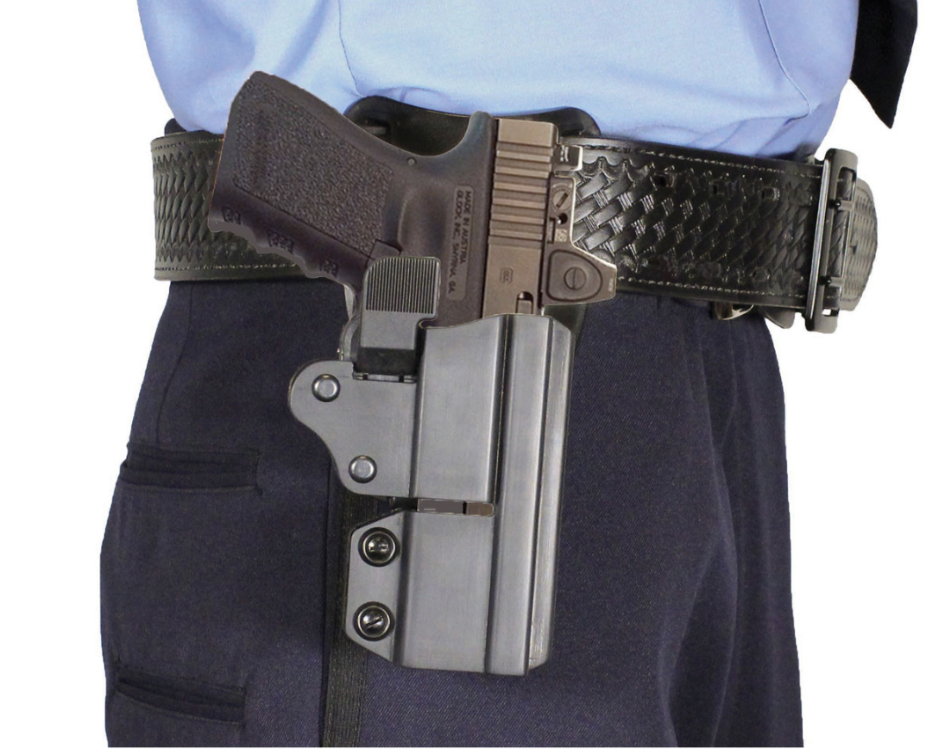
Your sidearm belongs in a holster with active retention rated for open carry in a crowd. Level II and Level III designs add mechanical steps between an assailant and your weapon, and NIJ guidance on officer safety equipment treats weapon retention as part of the same survivability picture as body armor.
DeSantis builds duty holsters across leather, molded Nylahide, and Kydex. The Pegasus Kydex duty line gives you a molded shell with consistent draw resistance in any weather, which is the argument for Kydex over leather on a duty rig. Position it on your strong side hip, and set the height so a full firing grip is available before the gun clears the holster.
3. Handcuff Case
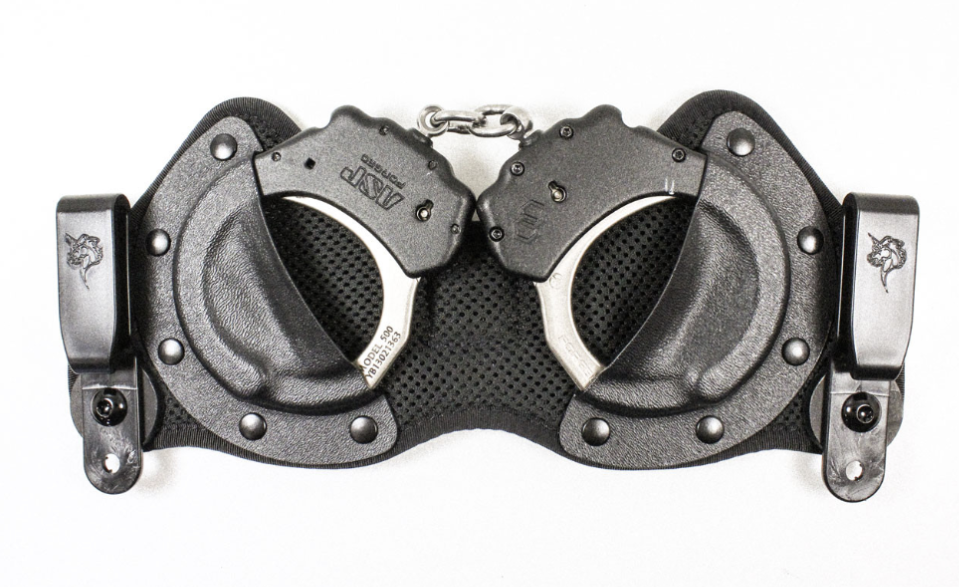
Most officers carry two sets of cuffs. Placement should let either hand reach at least one set, since a struggle rarely leaves you the hand you planned on. The FBI's Law Enforcement Officers Killed and Assaulted data records tens of thousands of line-of-duty assaults each year, most of them hands-on rather than armed.
The Veritas Handcuff Pouch is molded from thermoplastic with a weatherproof laminate flap and stainless steel snap, sized for 2.25-inch belt slots. If your agency runs leather, the duty cuff case in leather covers S&W, ASP, and hinged cuffs with a pull-the-dot snap for one-direction access.
4. Magazine Pouches
Spare ammunition needs to be reachable with your support hand while your strong hand stays on the gun. Double magazine pouches are standard on the support side.
The Veritas Double Magazine Pouch includes a tension device and can be worn horizontal or vertical depending on how your belt is laid out. Vertical eats less belt real estate. Horizontal is faster for some officers. Try both before you commit. The full Veritas line is built on the same 2.25-inch slot pattern, so the pieces sit at matching heights.
5. Pepper Spray
OC spray fills the gap between verbal commands and hands-on force, making it one of the most used items on the belt.
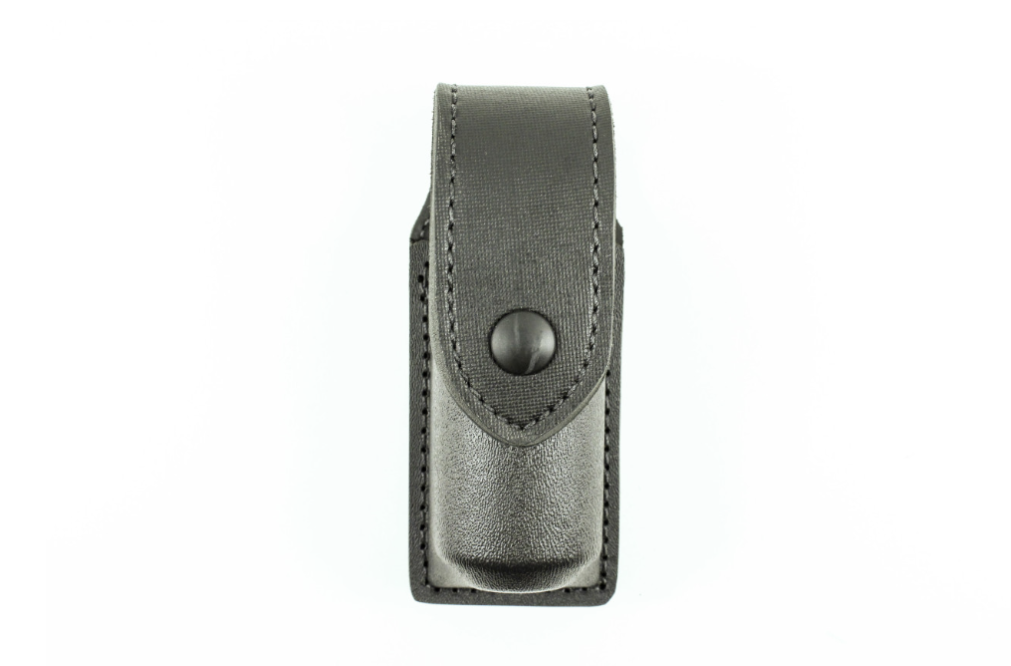
The Veritas OC/Spray Pouch secures through 2.25-inch belt slots with a protective flap and stainless steel snaps. Put it on your support side where your non-gun hand finds it without crossing your body.
6. Radio and Remote Speaker Microphone
Your radio is the tool that brings everyone else. It needs a pouch that holds it through a foot pursuit and releases it when you want it.
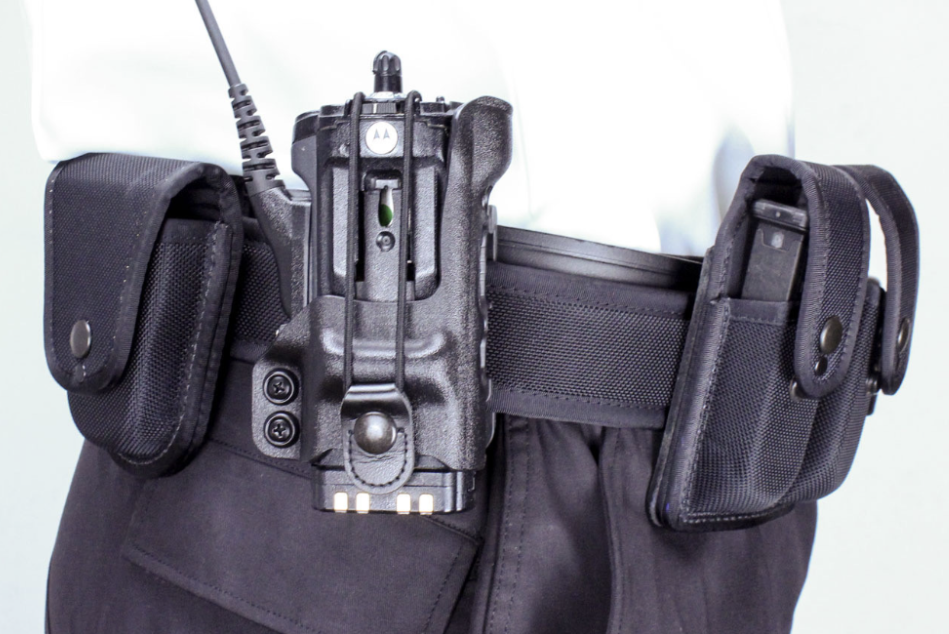
The Veritas Radio Pouch uses a swivel attachment so the radio moves with your body instead of levering against your hip when you sit. Run the remote speaker microphone up to your shoulder so you can transmit without reaching down. Consider the Radio Tender for a more tactical option.
7. Flashlight
A flashlight is a use-of-force tool, an identification tool, and a search tool. Even on day shift, you will use it inside buildings and vehicles.
DeSantis offers a Veritas flashlight pouch built on the same 2.25-inch belt slot pattern as the rest of the line, which keeps your setup consistent.
8. Gloves and Medical
Two items that earn their space:
- A glove pouch keeps nitrile gloves clean and immediately available. The Veritas Surgical Glove Pouch holds three pairs behind a hook-and-loop flap.
- A tourniquet and shears belong somewhere reachable with either hand. Many agencies mount these on a tactical vest instead, but belt placement works if the vest comes off.
Setting Up Your Belt
Once you have the gear, the layout decides how well it works.
- Strong side: holster, then flashlight behind it.
- Support side: magazine pouches forward, cuffs and OC behind them.
- Rear: radio on one side, nothing at the spine.
- Leave gaps between items. Crowded gear is slow gear.
- Wear the full rig at home for an hour before your first shift with it.
Then train. Draw, reload, and deploy every item until your hands know where things are in the dark. Functionality on a duty belt is not what the gear can do on a table. It is what you can do with it while your attention is somewhere else.
Build a Belt You Can Trust
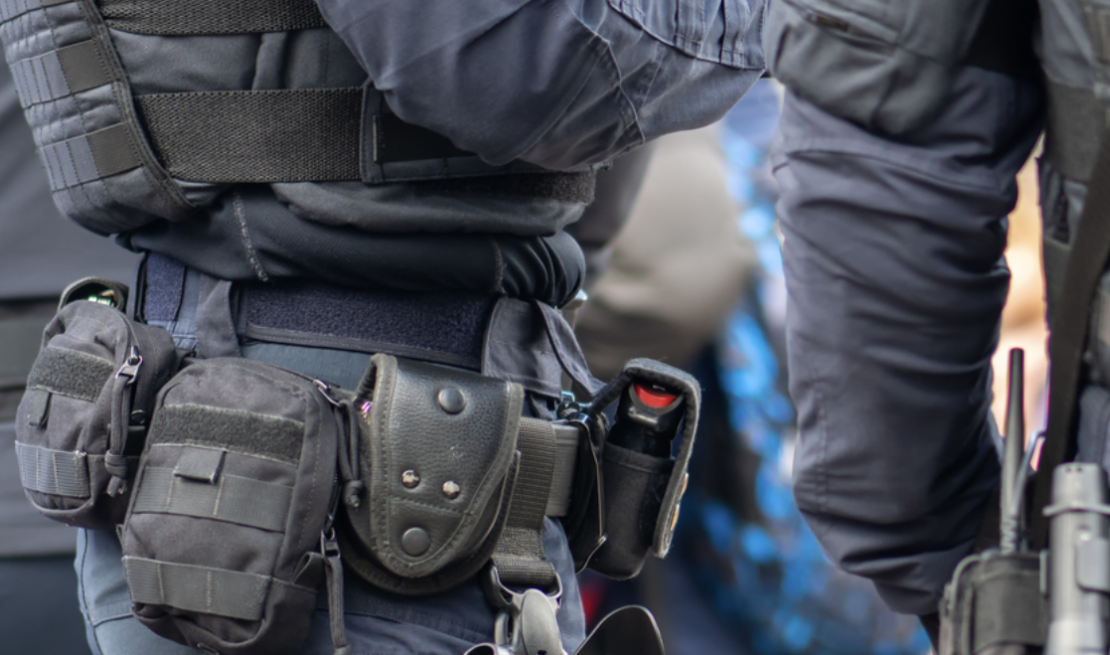
DeSantis has supplied law enforcement agencies with holsters and duty gear since Gene DeSantis made his first holster by hand, and the same quality control standard applies to a handcuff case as to a custom holster. Law enforcement officers do not get to swap out a failed pouch mid-shift, which is why high-quality construction and a clear warranty matter more here than on any other belt you will own. Everything is made in the USA by a family-owned company that has been at this for nearly fifty years.
Browse the DeSantis duty gear collection and build a belt that holds up for the length of your career.
