
Level 3 Holsters: What Sets Them Apart?
Jul 22nd 2026
Level 3 Holsters at a Glance
A level 3 holster is a retention holster with three points of security that hold your firearm in place until you deliberately release each one. That extra retention makes it the standard choice for duty carry, where an exposed sidearm needs protection from grabs and hard movement. Below, we break down how retention levels work, what makes a level 3 holster different, and how DeSantis approaches high-retention carry.
Most carriers start with a simple holster that holds the gun by friction alone. A level 3 holster goes further. It adds active retention mechanisms that an officer or carrier works through in order before the firearm clears the holster. The trade-off is real: more security on one side, a slightly slower draw on the other. For law enforcement and security personnel who carry all day openly, that trade is usually worth it.
This guide is written for anyone comparing retention levels for the first time, plus experienced carriers who want a clear refresher. We will define each retention level, look at the parts that set a level 3 holster apart, and cover where this kind of holster fits best. We will also show how DeSantis builds retention into its duty and concealment lines. By the end, you should know if a level 3 holster matches your setup or if a lighter retention level makes more sense.
What Is a Level 3 Holster?
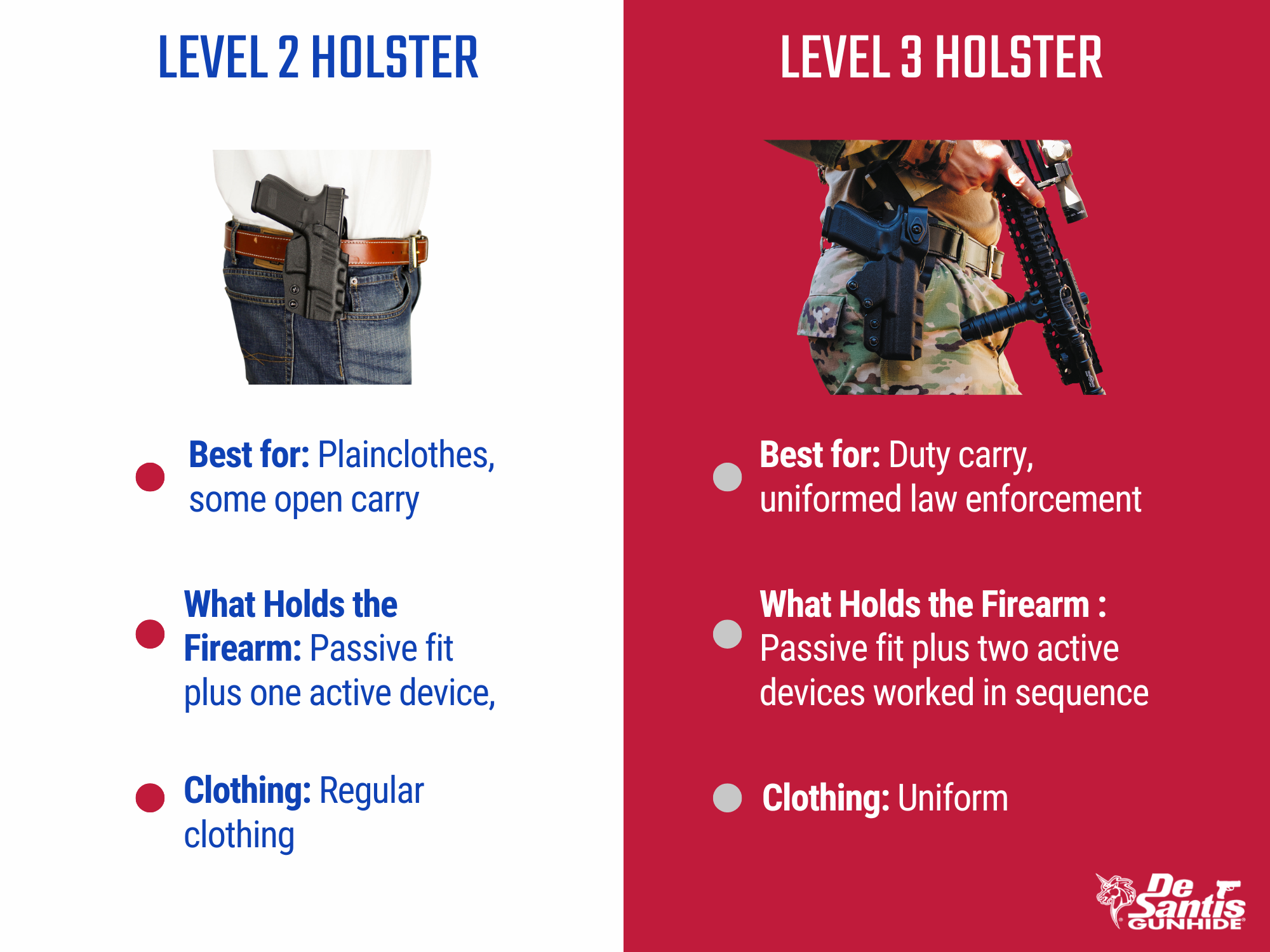
A level 3 holster uses three points of retention to keep a firearm secured. Retention level describes how many deliberate actions you take to draw, not how tight the holster feels. The higher the level, the more steps stand between a grab and a drawn gun.
Here is how the common retention levels break down. There is no single governing body that certifies these numbers, so makers may count them a little differently.
|
Retention Level |
What Holds the Firearm |
Common Use |
|
Level 1 |
Passive tension or friction from the molded fit |
Concealed carry, range use |
|
Level 2 |
Passive fit plus one active device, such as a thumb break or self-locking system |
Plainclothes, some open carry |
|
Level 3 |
Passive fit plus two active devices worked in sequence |
Duty carry, uniformed law enforcement |
A level 1 holster relies on the shape of the shell and an adjustable retention screw. A level 2 holster adds one active step, often a thumb break or a retention button. A level 3 holster stacks a second active step on top of that, so the firearm stays put even during a struggle. Many duty rigs reach level III by combining a hood or guard over the slide with a locking mechanism near the trigger guard.
Retention level is only one part of the picture. You also pick a material (leather, nylon, or Kydex), a carry position, and any cuts for a weapon-mounted light or optic. A level 3 holster built for duty carry usually rides on a belt or drop platform for fast, repeatable access.
What Sets a Level 3 Holster Apart?
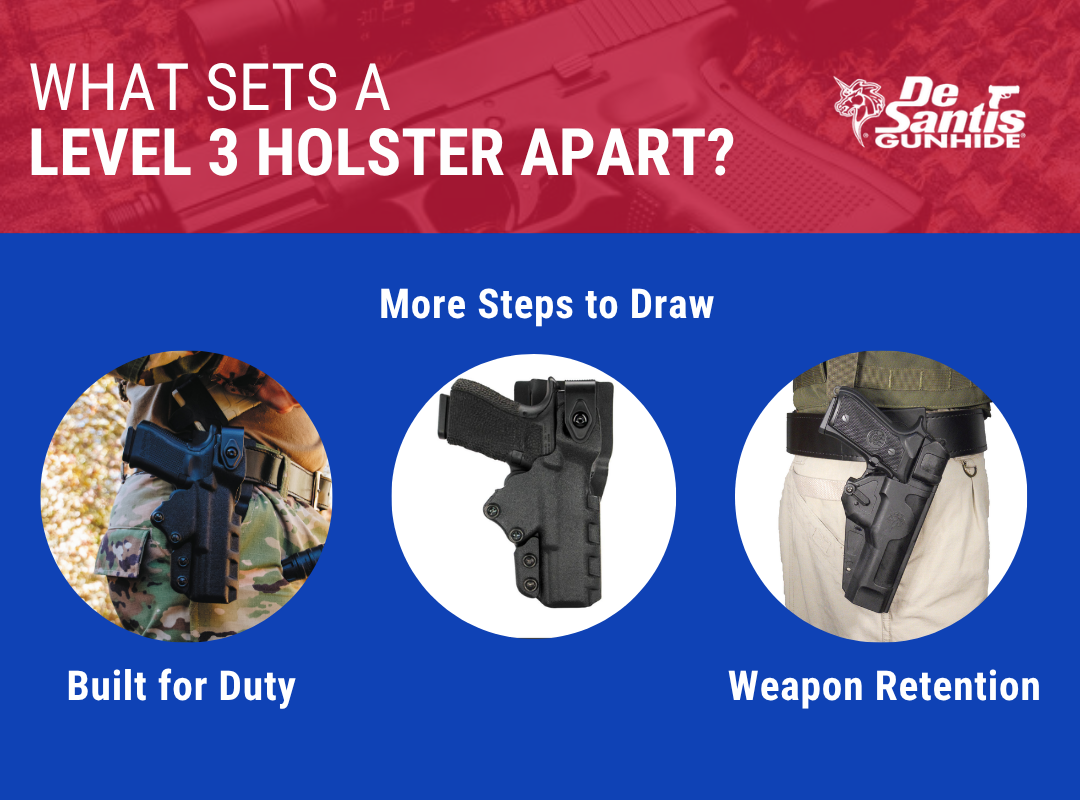
The difference comes down to retention mechanisms and the job they do. A concealed carry holster hides the gun, so the body and clothing add a layer of protection. A duty holster carries the firearm in the open, which means the holster itself has to do all the work.
More Steps to Draw, On Purpose
A level 3 holster asks for two deliberate moves before the firearm releases. A typical retention system might pair a rotating hood over the slide with a locking lever you press during the draw. Each step is simple once trained, but together they stop most grab attempts. This is why weapon retention matters most for law enforcement officers and security personnel who stand close to the public.
Built for Duty and Hard Use
Level 3 holsters are made for law enforcement and other open carry roles. They handle running, fighting, and vehicle work without letting go of the gun. Many models support a weapon light or red dot optic, since duty pistols often run light-bearing options and optics together. Look for an open-bottom design if you run a longer slide or a suppressor-height sight, since it clears the muzzle and any attached light. A low-ride belt drop or mid-ride setup helps an officer reach the firearm cleanly while wearing a full duty belt with a mag pouch and other gear.
Who Should Skip It
A level 3 holster is not the right call for everyone. For everyday concealed carry, the extra steps slow your draw without adding much real-world safety, because the gun is already hidden. Most private citizens carrying compact firearms are better served by a level 1 or level 2 holster. Choose a level 3 holster when open carry, duty work, or a high-contact job puts your firearm within reach of others.
DeSantis and High-Retention Carry
DeSantis Gunhide has built holsters in the United States since 1972, with all products handmade on Long Island in leather, nylon, and Kydex. The company is known for matching new firearm releases quickly and for the tagline "Concealment, Perfected." That concealment focus now reaches into higher-retention, duty-rated designs.
Retention Built Into the Shell
DeSantis uses its own retention systems rather than borrowing another brand's. The Prowler is a self-locking level II holster built on the Redi-Lok system, which locks the firearm in place until you press the release. The Gunhide Retention Device, or GRD, is a Kydex shell molded for gun-specific retention that holds the firearm without a separate strap. These systems give carriers a clear path from simple concealment up to active weapon retention.
The Quick Safe and Level III Testing
DeSantis's Quick Safe is a self-locking Kydex holster that earned duty-rated approval from U.S. Customs and Border Protection, Air and Marine Operations, and the Federal Protective Service in 2026. According to the company, the Quick Safe passed testing standards usually reserved for level III duty rigs while keeping a fast draw (Source: DeSantis Gunhide, 2026). It fits popular Glock and M&P models, including exact setups that clear a weapon light such as a Streamlight TLR.
When you pick a high-retention holster, confirm three things before you buy: that it matches your exact firearm and slide length, that it clears any light or optic you run, and that you can work the retention release the same way every time. A holster you cannot draw from under stress does not help you, so plan on dedicated training once your setup arrives.
Made in the USA, Backed by Service
Every DeSantis holster is American-made, and the company supports both law enforcement agencies and private carriers across the United States. If you are not sure which retention level or exact setup fits your firearm, DeSantis customer service can match you to the right duty holster or concealment rig by phone or email.
The Bottom Line
A level 3 holster stands apart because it adds two active retention steps to a secure molded fit, which protects an openly carried firearm during close contact and hard movement. That makes it the standard for duty carry and uniformed law enforcement officers, while most concealed carriers are well served by a level 1 or level 2 retention holster. The right choice comes down to how you carry, where you work, and how much retention your day actually calls for.
DeSantis brings that same retention thinking to American-made leather and Kydex holsters, from simple concealment up through self-locking and duty-rated designs. If you are ready to step up your retention level, browse the DeSantis duty holster lineup or reach out to customer service for help matching a holster to your Glock, M&P, or other firearm. Find the setup that keeps your sidearm secure and ready when it counts.
