

Can Truck Drivers Carry Firearms? What the Law Actually Says
Oct 1st 2026
The Short Haul Answer
Carrying a firearm in a big rig comes down to three rulebooks stacked on top of each other, not one simple yes or no.
Here is what truck drivers need to know at a glance:
- No federal regulation from the FMCSA bans a firearm in a commercial motor vehicle.
- Federal law does control how you transport a gun across a state line, and the details are strict.
- State laws vary widely, and the strictest state on your route sets your real limit.
- Company policy can prohibit firearms in company trucks even where the law allows them.
- Rising cargo theft and long hours on the road are why many drivers weigh carrying in the first place.
- A dedicated car holster keeps a firearm secure and reachable where carry is legal.
Truck drivers cross state lines every day, and a firearm that is legal in the state behind you can turn into a criminal charge in the state ahead. Sorting out the rules before you load up is the difference between lawful protection and losing your CDL.
The information here is general and not legal advice, so confirm current law in every state on your route and your carrier's written policy before you carry.
Can Truck Drivers Carry Firearms? The Direct Answer
Yes, in most cases a truck driver can legally carry a firearm, but not everywhere and not automatically. No rule from the Federal Motor Carrier Safety Administration prohibits it. The FMCSA has stated on the record that it has no jurisdiction over firearm possession by CMV drivers in interstate commerce, which leaves the question to other laws.
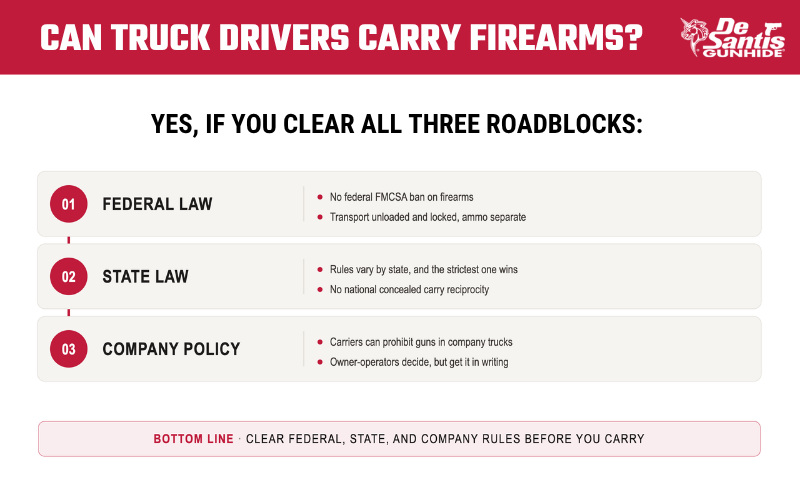
The Federal Motor Carrier Safety Regulations simply do not address carrying a weapon in a commercial motor vehicle. A driver follows the same firearm laws as any other citizen. That sounds simple until you remember a trucker passes through many states in a single run, each with its own rules. Here is how the three layers stack up:
| Layer | What It Controls | Bottom Line for Drivers |
|---|---|---|
| Federal law | Transporting a firearm across state lines | Generally allowed when unloaded and locked away separately |
| State law | Carrying, loaded storage, and permits in each state | Varies widely; the strictest state on your route wins |
| Company policy | Firearms in company-owned trucks | Can ban guns outright, even where state law allows them |
What Federal Law Says About Guns in a Commercial Vehicle
Federal law protects transporting a firearm, not carrying it loaded for defense. Under 18 U.S.C. § 926A, the Firearm Owners Protection Act, any person may move a firearm across state lines if it is unloaded and neither the gun nor the ammunition is readily accessible from the passenger compartment. The firearm must be legal to own at both the start and the end of the trip.
That protection has sharp edges. In a truck with no separate trunk, the firearm and ammunition must sit in a locked container that is not the glove compartment or the center console. The safe-transport clause stops applying the moment the gun is loaded or within reach, which is exactly what a driver carrying for self defense wants. In short, federal law gives you a lawful way to haul a firearm on a peaceable journey, but it does not hand you a loaded gun in the driver's compartment.

State Laws and the Reciprocity Problem
State law is where most drivers actually get into trouble. There is no national concealed carry reciprocity, so a permit from your home state may mean nothing three states later. A driver can be carrying legally in one state that morning and committing a crime in the next state by that afternoon on the same load.
The gap between states is wide. Some let any lawful gun owner keep a loaded handgun in a private vehicle under a traveling or peaceable journey provision, while others require a carry permit for a loaded firearm in the cab at all. For example, Texas generally allows lawful gun owners to carry in a vehicle, while California requires a permit to carry a loaded firearm in one. Roughly 21.46 million Americans held concealed carry permits in 2024, per the Crime Prevention Research Center, yet a permit still only travels as far as each state's reciprocity rules allow. Getting it wrong can mean criminal charges or even felony charges, so map your route against every state's firearm law before you roll.
Company Policy: The Rule That Gets Truckers Fired
Even where federal and state law say yes, your employer can still say no. A trucking company can prohibit firearms in company-owned trucks as a condition of employment, and many carriers do exactly that. Company drivers are bound by that written policy, while owner-operators who own their own rigs have more freedom to decide for themselves.
The stakes are real. Violating a carrier's firearms policy can cost a driver the job, and breaking a state's gun law on top of it can bring fines or prison time. Before you carry, take two steps:
- Ask your safety manager for the written company policy on firearms, and get the answer in writing rather than secondhand.
- If you are an owner-operator, research the carry and transport laws for every state on your lane yourself, since no dispatcher will do it for you.
Legal compliance protects both your safety and your livelihood, and the two are not always in tension when you plan ahead.
Why Truck Drivers Consider Carrying
For many drivers, the motivation is simple: long hours, remote stops, and valuable freight. Cargo theft reached record levels recently, with 3,625 reported incidents across the United States and Canada in one year, a 27% jump and about $455 million in losses, according to Verisk CargoNet. A driver parked overnight at a rest area is often the last line of defense for a trailer worth six figures.
The population weighing this question is large. The American Trucking Associations counts 3.58 million truck drivers employed in 2024, many of them alone on the road for days at a time. Firearm ownership is common ground for that group, with about 32% of U.S. adults owning a gun and protection cited as a top reason, per the Pew Research Center. For drivers who choose to carry within the law, personal safety and the right to bear arms are the drivers behind the decision.
Holsters Built for the Cab: Easy Access Behind the Wheel
Where carrying loaded is legal and your employer allows it, access is everything. A seatbelt and a steering wheel turn a normal waistband draw into a fumble, and a loose gun in the glove compartment is both slow to reach and, if loaded, often not a legal storage spot. A holster made for the vehicle solves both problems at once by holding the firearm in a fixed, reachable place.
| Option | Access While Seated | Security |
|---|---|---|
| Car seat holster | Fast and within reach when belted | Held firmly in place |
| Shoulder holster | Good, clears the seatbelt | Worn on the body |
| Off-body bag | Slower, needs two hands | Portable in and out of the cab |
| Glove compartment | Slow and awkward | Loose, often not a legal locked container |
DeSantis builds carry gear made for exactly this situation:
- The Kingston Car Seat Holster mounts to the front edge of the seat between your legs, keeping a concealed firearm reachable without wrestling your seatbelt.
- The Gunny Sack is a belt-pack holster that carries discreetly in the cab and comes with you when you step down from the truck.
- For carry that leaves the vehicle with you, the most comfortable concealed carry holsters roundup covers all-day options worth pairing with a car rig.
Carry Smart, Stay Legal
Whether a truck driver can carry a firearm comes down to clearing all three layers: the federal transport rule, the law in every state on your route, and your carrier's written policy. Confirm those first, then set up carry gear that actually works from the driver's seat.
DeSantis Gunhide has hand-built American holsters in the United States since 1972, family-owned, with quality control behind every stitch and rivet. Shop DeSantis holsters and set up a rig that keeps you protected and road-legal.
